
Designing for Coherence
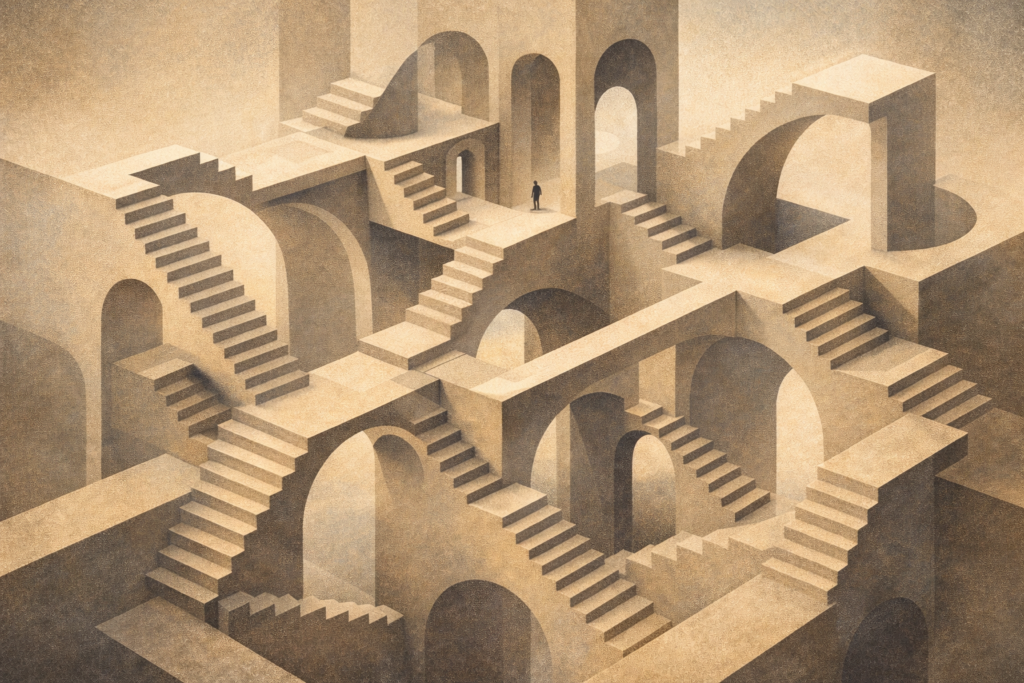
I almost always begin my creative thinking in the present moment, out of necessity. It is the only place from which I can reliably feel. Even when what I am trying to understand lies far behind me—historically or personally—I have learned that any inquiry not anchored in the body’s current state risks drifting into abstraction.
In my own case, cognitive well-being does not organise itself primarily around ambition or forward momentum. It coheres around a quieter set of interior drives: meaning-making, curiosity, aesthetic attunement, self-expression. These are not hobbies or personal flourishes. They function more like stabilising systems. When they are active, my inner life holds together. Attention integrates. Time feels inhabitable. When they are interrupted or fragmented, something subtler than unhappiness emerges—an erosion of coherence that no amount of busyness or external success compensates for.
This coherence is not mysterious, and it is certainly not immune to material reality. It depends on conditions. Health matters. Social safety matters. Financial sufficiency matters. I am not interested in romanticising artistic precarity or treating financial constraint as a moral virtue. A nervous system under sustained threat does not become insightful; it becomes vigilant. Its bandwidth narrows. Only when basic pressures recede does this deeper cognitive register—capable of reflection, patterning, and symbolic thought—reliably surface.
What has begun to intrigue me, however, is not the obvious truth of this dependence, but a quieter dissonance beneath it. These interior drives do not feel newly acquired, nor do they behave like luxuries unlocked by comfort. They do not register as Maslovian afterthoughts earned once the serious business of living is complete. They feel older than that—necessary in a way that predates productivity, or even safety.
This recognition has altered the direction of my curiosity. Rather than asking what modern conditions allow these capacities to become, I find myself turning backward—toward a question that unsettles a familiar contemporary story. If meaning-making, curiosity, and aesthetic attunement stabilise the mind now, under comparatively forgiving conditions, what role did they play when conditions were anything but forgiving?
What, exactly, was the human mind doing with these capacities when the world offered far less margin for error?
Meaning Before Safety
Once the question is asked plainly, it becomes difficult to set aside. If these interior capacities stabilise cognition under relatively benign conditions, what were they doing when benign conditions were rare? What role did meaning-making, curiosity, and symbolic attention play when the world was structured for survival under uncertainty?
The modern story often assumes a sequence: first safety, then culture; first survival, then meaning. Under this account, aesthetic or symbolic cognition appears as surplus—something layered atop biological necessity once immediate threats are managed. Art follows abundance. Reflection follows rest. Meaning follows margin.
But the archaeological and anthropological record complicates this story almost immediately.
If we look back broadly—across late hunter-gatherer societies, early agrarian settlements, and the emergence of the first symbolic civilisations—we encounter radically different material conditions. Mobility gives way to settlement. Ecological uncertainty is replaced by seasonal dependency. Kinship networks thicken into hierarchy; ritual practice becomes institutional. These were not the same worlds. Their pressures differed in kind as well as degree.
And yet, across this variation, something persists.
Consider the cave paintings of Lascaux or Altamira, which map the seasonal migrations of herds. These were not decorative murals but survival manuals—visual almanacs that preserved critical knowledge in a form that could be recalled and shared without writing.
We find deliberate burial practices accompanied by ornamentation and grave goods. We find rhythmic markings etched into bone and stone, repeated across sites and millennia. Whatever else these societies lacked, they were not worlds without symbolic behaviour.
This continuity is the first disruption of the modern assumption. Human minds did not wait for safety to begin making meaning.
This does not mean that early humans were abstract philosophers or artists in any modern sense. It means something subtler and more consequential: that the cognitive capacities we now associate with art, ritual, and reflective interiority were active long before they could plausibly be classified as self-expression.
If symbolic behaviour emerges reliably under constraint, it cannot be explained as ornament alone. Its persistence suggests an orienting function—not decorative, not aesthetic in the contemporary sense, but adaptive in a deeper register.
The evidence is unambiguous on that point. The more difficult question is why such behaviour would be metabolically affordable—let alone evolutionarily stable—under conditions where energy, attention, and time were so tightly constrained.
What problem, exactly, was meaning solving?
Compression and Survival
To answer that question, we have to let go of the modern categories that obscure more than they clarify. What we now label “art” or “aesthetics” did not begin as discretionary activities. They functioned as orientation systems—ways of making a volatile world cognitively navigable under conditions of limited information and high consequence.
These practices operated as compression technologies. They condensed complex ecological, social, and emotional knowledge into forms that could be remembered, transmitted, and enacted without written language or formal abstraction. A cave painting was not an artwork in the modern sense. It was a mnemonic interface: encoding animal behaviour, migratory rhythms, shared cosmology, and situational awareness into a visual field that could be revisited and reactivated. A chant was not entertainment. It was a memory scaffold—rhythmic, embodied, and resilient to distortion—capable of carrying procedural knowledge across time. Ornamentation was not vanity but signalling: who belonged, who shared obligation, who could be trusted in environments where misrecognition carried real risk.
The mechanism matters. Compression works by binding perception, emotion, and narrative into a single cognitive packet. Instead of storing information abstractly, early humans stored it relationally—through story, rhythm, image, and ritual. These forms were durable precisely because they recruited the nervous system itself. They were felt, enacted, repeated. They survived distraction because distraction was not an available state.
Curiosity, too, looks different when stripped of its modern association with idle novelty. In early contexts, curiosity was the cognitive expression of prediction under uncertainty: noticing subtle shifts in animal movement and changes in weather patterns. The curious individual was finely attuned, because attunement reduced error. It conserved energy. It increased the odds of alignment between expectation and reality.
Meaning itself also predates belief. Belief systems emerged later, as stabilising frameworks around something more emotionally fragile and immediate. Early humans asked a simpler question: what keeps the world coherent enough to live in?
Ritual made death narratable. Story made loss survivable. Symbol made effort feel cumulative rather than futile.
This is regulatory, not mystical. A nervous system that cannot integrate suffering does not become wiser; it becomes exhausted. Despair is metabolically expensive. Meaning-making conserves energy by allowing pain, loss, and uncertainty to be metabolised rather than continually re-triggered. In this way, symbolic cognition stabilised individuals and groups across time by making life bearable enough to remain engaged.
Seen through this lens, meaning-making was never a reward for survival. It was part of the machinery that made survival without psychological collapse possible.
Present Conditions
For most of human history, life was lived under conditions of managed scarcity—structured through kinship systems, religious institutions, agrarian cycles, feudal obligations, and early city-states. Meaning-making did not disappear under these arrangements, but it was often captured or externally administered. Symbolic life remained shared and durable, but continuous authorship of one’s interior world became rarer.
What is historically unusual, then, is not meaning-making itself, but continuity of interior space.
Under modern conditions—unevenly distributed, precarious, and historically anomalous—something occasionally becomes possible: a life after triage. Not a life without danger, but one in which danger no longer colonises every hour of attention. For a small fraction of the global population, cognitive resources are no longer permanently hijacked by immediate survival. The nervous system is no longer organised exclusively around threat mitigation.
This is where I locate myself.
Not as someone living beyond biology, but as someone living after triage, with all the fragility that status implies. The coherence I experience is conditional—framed by circumstances that remain historically rare.
Seen this way, contemporary dismissals of meaning-making and its attendant artistry—as indulgent or secondary—reveal a quiet antagonism toward deeply human capacities that resist instrumentalisation. A culture shaped by productivity metrics and narrow hierarchies of value struggles to recognise forms of cognition that do not resolve neatly into output. Meaning is often tolerated as entertainment, permitted as reward, but rarely acknowledged as essential infrastructure.
What is occurring here is not transcendence, but recovery. These are not new faculties emerging, but ancient structures given room to operate without interruption, providing cohesion to conscious, daily awareness.
More accurately, it is a remembrance of what the human mind has always been capable of—when we give it just enough time to speak. Not fluently. Not effortlessly. But in full sentences.